
IASTM BLADING.
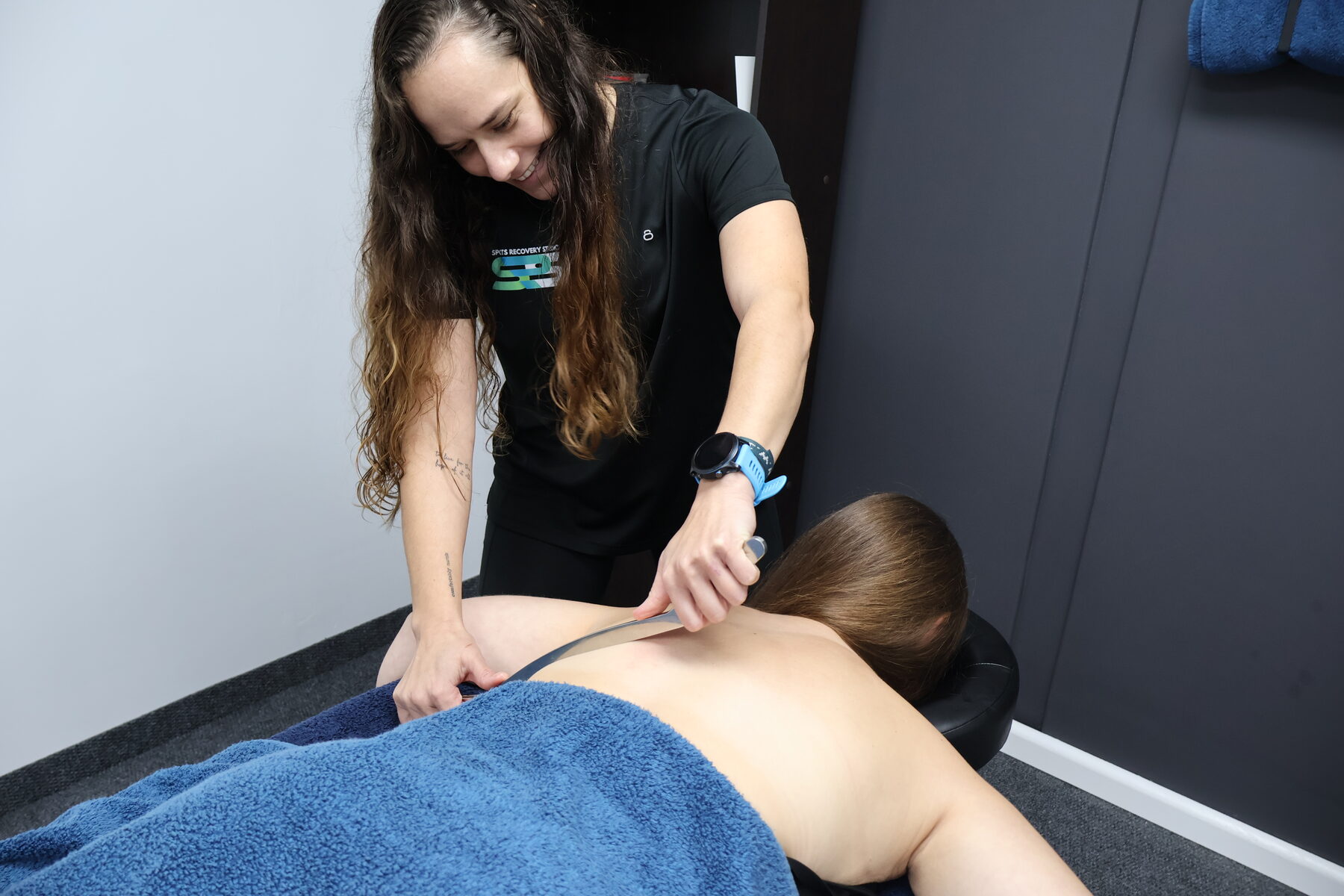
Instrument-assisted soft tissue massage: specialised tools glide along muscle and fascia to break down scar tissue and improve mobility.
- DURATION15–20 MIN
- BOOKEDWITHIN A MASSAGE
- TARGETFASCIA / SCAR TISSUE
- INTENSITYMODERATE/PRECISE
Not sure this is the right session for you? WhatsApp us and we'll point you right.
WHAT IS IASTM OR BLADING?
Instrument Assisted Soft Tissue Manipulation — blading for short — uses handheld stainless steel or plastic instruments to find and treat areas of soft tissue restriction.
The tool does something hands can't: it transmits vibration back through the therapist's fingers. Healthy tissue feels smooth under the blade, restricted tissue feels gritty. That feedback lets your therapist locate adhesions precisely rather than working by feel alone.
Once located, the instrument glides over the area to break down adhesions, scar tissue and fascial restriction, improve circulation and reduce tension.
WHAT A SESSION IS LIKE.
OIL DOWN
Massage oil or emollient goes on so the tool glides rather than drags.
SCAN
Your therapist sweeps the instrument over the area, feeling for the gritty texture that flags restriction.
TREAT
Focused strokes across and along the restricted tissue break down adhesions and scar tissue.
MOVE IT
Active movement or stretching while treating helps the tissue reorganise along the right lines.
FINISH BY HAND
Hands-on massage settles the area afterwards.
WHY PEOPLE BOOK IT.
PAIN RELIEF
Releases tension and adhesions within muscle and fascia that pressure alone can't reach.
SCAR TISSUE BREAKDOWN
Particularly useful over old surgical scars and long-standing injury sites.
MORE MOBILITY
Freeing fascial restriction restores range of motion that stretching alone hasn't fixed.
BETTER CIRCULATION
Stimulates blood flow into the treated area to support healing.
FASTER RECOVERY
Speeds recovery from overuse injuries like shin splints, IT band pain and tennis elbow.
- +SCAR TISSUE
- +STUBBORN KNOTS
- +RANGE OF MOTION
- —Broken or infected skin, open wounds or fresh scars still healing
- —People on blood thinners or with bleeding disorders
- —Over varicose veins or areas of known DVT
Unsure whether something on this list applies to you? Ask us first.
AFTER YOUR SESSION.
- →Mild redness or a pink flush over the treated area is normal and settles within hours.
- →Some clients get light bruising — usually where the tissue was most restricted.
- →Keep moving. Gentle range-of-motion work after blading helps the tissue remodel properly.
- →Hydrate, and avoid heavy training on the treated area for 24 hours.
QUESTIONS WE GET ASKED.
Is blading the same as Graston technique?
+
Graston is one branded system of instrument assisted soft tissue mobilisation. Blading is the general term for the same approach using stainless steel or plastic tools. The principle is identical: locate restricted tissue by feel through the instrument, then treat it with focused strokes.
Does blading hurt?
+
It's a scraping pressure that can be intense over a genuinely restricted spot, but shouldn't be sharp or unbearable. Your therapist controls the angle and pressure, so speak up and they'll ease off. Most people find it more tolerable than deep elbow pressure on the same area.
Will I bruise?
+
Light redness is normal and fades within hours. Some people get mild bruising over the most restricted areas. Tell your therapist if you bruise easily and they'll use a lighter approach.
What is blading best for?
+
Old scar tissue, chronic overuse injuries and fascial restriction that hasn't responded to stretching or standard massage. Shin splints, IT band pain, plantar fascia, tennis elbow and post-surgical scars are the most common reasons we reach for the tools.
PAIRS WELL WITH.
SPORTS MASSAGE
Deep, targeted massage for recovery, injury prevention and performance — for athletes and desk-sitters alike. Cupping and blading included where your body needs it.
MORE INFO →MYOFASCIAL CUPPING
Gentle suction lifts and decompresses tight tissue, drawing fresh blood to the area to release tension and speed up recovery.
MORE INFO →SHOCKWAVE THERAPY
High-energy acoustic waves that reach stubborn, chronic pain — tendons, heels and shoulders — without needles or surgery.
MORE INFO →READY WHEN YOU ARE.
IASTM BLADING is booked through Fresha — our live diary with real-time availability. Fresha doesn't allow its calendar to be embedded, so the button opens it in a new tab.
SEE REAL-TIME AVAILABILITY AND BOOK IASTM BLADING.
Choose your therapist, date and time, and confirm in under a minute. Prefer to ask first? Message us on WhatsApp and we'll book it for you.
NOT SURE WHERE TO START?
Tell us what's sore, stiff or slowing you down — we'll point you to the right session.